
Climbing Higher: The Gift of Outdoor Play at Village Playgarden
There is something timeless about a child climbing a tree.
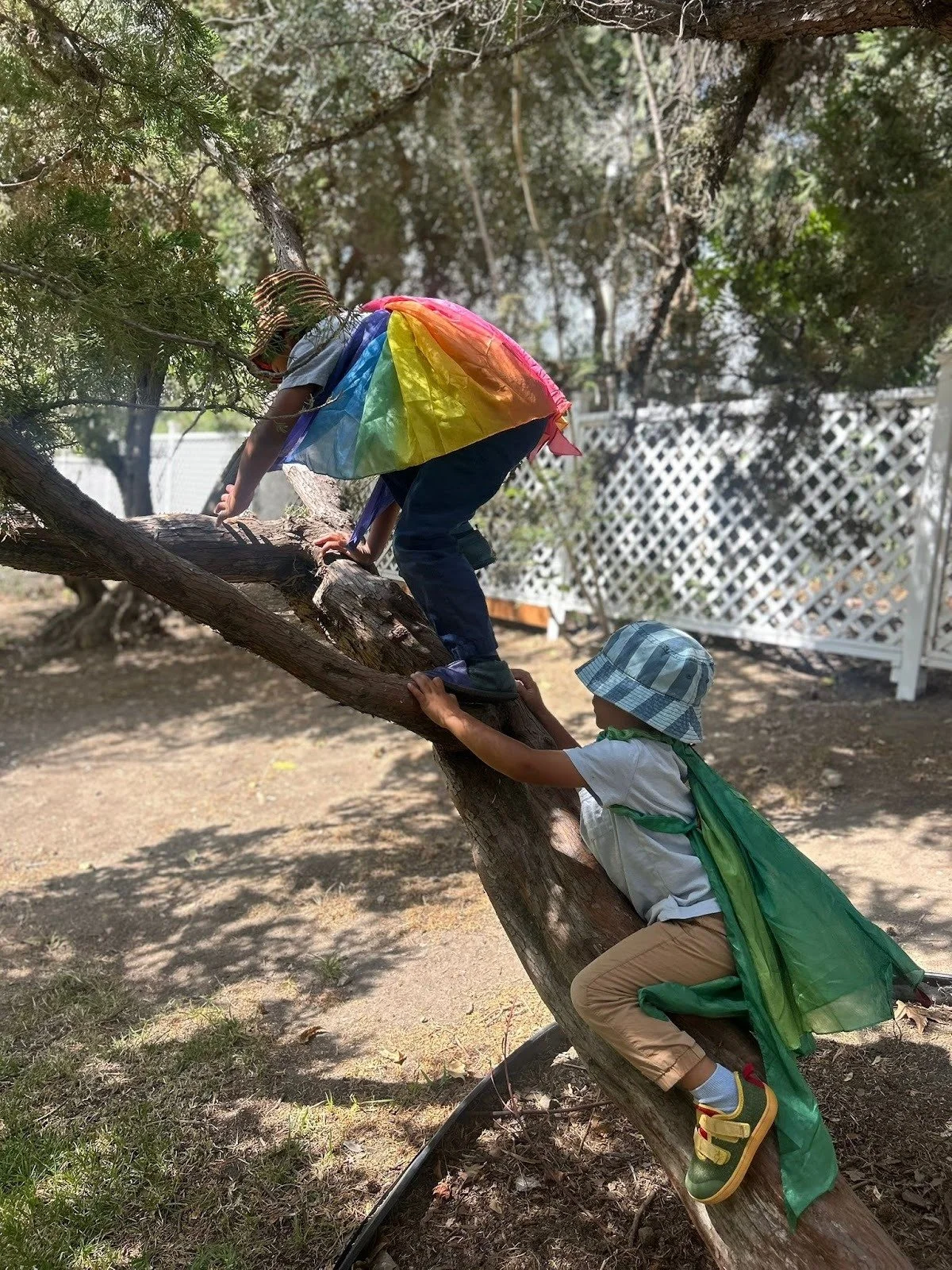
In the image above, two young children carefully make their way up a sturdy branch. Their capes flutter behind them in bright colors. One child climbs with focused determination while the other steadies himself below, preparing for his turn. No screens. No step-by-step instructions. Just sunlight, wood, balance, and imagination.
At Village Playgarden, this is not a “special activity.” It is childhood.
Outdoor play isn’t treated as a break from learning here. In Waldorf early childhood education, it is part of the learning itself. When children climb, balance, jump, dig, and explore in nature, they aren’t just releasing energy. They are building strength, coordination, awareness, and confidence. They are developing the inner capacities that will support them not only in kindergarten, but throughout life.
Tree climbing offers a beautiful window into this process. A child reaches for a branch and makes a decision. Is it stable? Can I stretch that far? Where should I place my foot? These questions are not theoretical. They are lived experiences, unfolding moment by moment. Children learn to listen to their bodies and read their environment. They develop judgment because they are allowed to practice it.
Within a thoughtfully held outdoor space, children begin to understand what they are capable of. They might slip. They might pause and reconsider. They might climb down and try again from a different angle. Over time, this becomes more than physical skill. It becomes resilience. When children are trusted with manageable challenges, they grow steady and self-assured. Their courage is not rushed or forced, it develops naturally.
Imagination deepens this experience even further. At Village Playgarden, children often wear simple play silks and capes, like the ones seen here. These open-ended materials invite storytelling and transformation. A cape becomes wings. The branch becomes a mountain, a ship, or a lookout tower. Nature does not dictate how play should unfold. It simply offers itself, and children respond with creativity.
This is one of the greatest gifts of outdoor play: it engages the whole child. Movement and imagination are woven together. Children are not pretending in their minds while their bodies do something separate—they are living the story fully. This kind of play strengthens narrative thinking, language development, social skills, and emotional flexibility in ways that structured, adult-led activities often cannot.
Our outdoor environment is intentionally simple. Trees, logs, earth, sand, water, and open sky provide endless possibilities. Because these elements are always changing, the play is never the same twice. A branch feels different in the morning shade than in the warmth of afternoon light. The ground shifts with the seasons. The air carries new scents and sounds. Through this daily relationship with nature, children develop adaptability and reverence. They begin to care for the world around them because they experience themselves as part of it.
Over time, this foundation supports later learning in profound ways. Climbing strengthens core stability and coordination, which later supports writing. Balancing builds concentration and body awareness. Imaginative storytelling strengthens language and comprehension. When children have fully lived in their bodies and senses, they are far more prepared for academic learning when the time is right.
At Village Playgarden, outdoor play is woven into each day because we trust the wisdom of early childhood. You can learn more about our approach through our early childhood program and explore additional reflections on daily rhythms and seasonal life on our blog.
We do not rush childhood. We protect it. We offer a space where children can explore within loving boundaries, meet real challenges in a safe and natural way, and grow strong in body and spirit.
If you are wondering whether this kind of environment might be right for your child, we invite you to reach out to us and begin a conversation.
Because sometimes, the most important work a child can do is simply climbing a tree.